


EMILIO AGUINALDO MONUMENT REINSTALLED IN BACOOR CITY
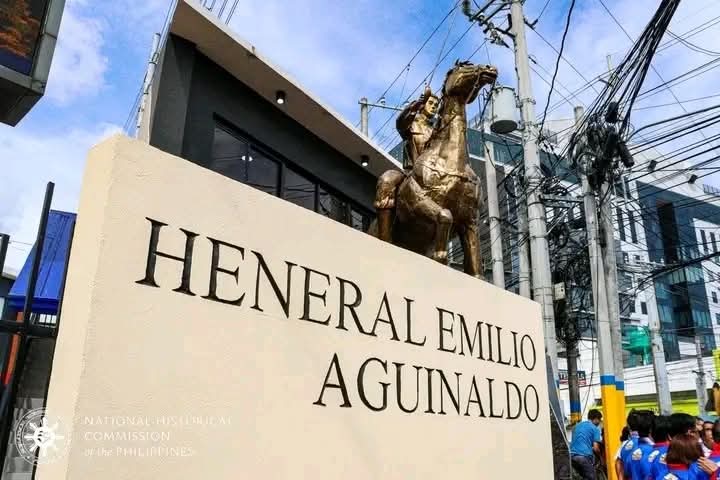
BACOOR CITY — A monument honoring Gen. Emilio Aguinaldo, the first president of the Philippine Republic and one of Cavite’s most celebrated native sons, was formally rededicated in Bacoor City on June 23, 2026 at the corner of Aguinaldo Highway and Bacoor Boulevard.
The National Historical Commission of the Philippines, in partnership with the Bacoor city government, led the unveiling ceremony attended by Cavite Gov. Francisco Gabriel Remulla, Vice Gov. Ramon Vicente Revilla, 2nd District Rep. Lani Mercado-Revilla, Bacoor City Mayor Strike Revilla, and NHCP Deputy Executive Director for Programs and Projects Alvin Alcid.
The statue was first erected in 1997 near the Bacoor exit of the Coastal Road as part of preparations for the Philippine Centennial Celebrations. It was later relocated to General Emilio Aguinaldo National High School in Imus City when road expansion converted the Coastal Road into the Manila-Cavite Expressway. Through the joint efforts of the Bacoor and Imus local governments, the monument has been returned to a prominent public thoroughfare.
BACKGROUND
Aguinaldo was born on March 22, 1869, in Cavite el Viejo — now Kawit, Cavite — into a family of Chinese-Filipino descent that was prominent in local politics. He became one of the principal leaders of the Katipunan revolutionary movement against Spanish colonial rule and later commanded Filipino forces during the Philippine-American War.
On June 12, 1898, Aguinaldo proclaimed Philippine independence from the balcony of his ancestral home in Kawit, an act commemorated annually as Philippine Independence Day. He was inaugurated as the first president of the Philippine Republic on January 23, 1899, in Malolos, Bulacan, presiding over the First Philippine Republic — also known as the Malolos Republic — until its collapse under American military pressure.
His revolutionary career was marked by both celebrated victories and deep controversy. He ordered the executions of fellow revolutionary leaders Andres Bonifacio in 1897 and Antonio Luna in 1899, acts that have cast a long shadow over his historical legacy. He surrendered to American forces in 1901 and took an oath of allegiance to the United States, effectively ending organized resistance to American colonial rule.
Aguinaldo lived to see Philippine independence restored on July 4, 1946, and remained a public figure well into the 20th century, running unsuccessfully for president in 1935 against Manuel Quezon. He died on February 6, 1964, at the age of 94.
Discover more from Cavite News
Subscribe to get the latest posts sent to your email.