


LEAKED FILES REVEAL BILLIONS IN BUDGET ‘INSERTIONS’ FOR CAVITE LAWMAKERS
Cavite, Philippines — Leaked internal documents from the Department of Public Works and Highways (DPWH) have exposed a massive disparity between proposed infrastructure funding and final budget allocations for Cavite, revealing billions of pesos in alleged congressional “insertions” for the 2025 fiscal year.
The documents, dubbed the “Cabral Files” after the late DPWH Undersecretary Maria Catalina Cabral, provide a rare granular look at how the National Expenditure Program (NEP)—the President’s original budget proposal—is dramatically altered before becoming the General Appropriations Act (GAA).
In Cavite alone, the analysis shows that nearly every legislative district saw its budget swell by hundreds of millions, and in some cases over a billion pesos, through “restored” and “allocable” funds.
The Cavite Windfall
According to the leaked summary dated Sept. 4, 2025, the budgetary shifts for Cavite’s representatives include:
● Rep. Ramon Jolo Revilla III (1st District): Saw a total budget of P2.91 billion, which includes P1.56 billion in “NEP Restored” funds—additions made after the initial executive proposal.
● Rep. Adrian Jay Advincula (3rd District): Received P2.05 billion, with P1.37 billion flagged as restored allocations.
● Rep. Antonio Ferrer (6th District): Allocated P2.38 billion, nearly half of which (P982 million) consists of restored items.
● Rep. Jesus Crispin “Boying” Remulla (7th District): Despite his role as Justice Secretary, the district budget handled by the DEO reached P2.85 billion, with P1.87 billion added to the initial proposal.
● Rep. Aniela Bianca Tolentino (8th District): Recorded the highest restored amount among the first batch of districts at P1.96 billion, bringing the total district budget to P3.59 billion.
● Other Cavite leaders, including Lani Revilla (2nd District), Elpidio Barzaga Jr. (4th District), and Roy Loyola (5th District), also oversaw budgets ranging from P2.1 billion to P3.8 billion, with “restored” portions frequently exceeding P1.2 billion per district.
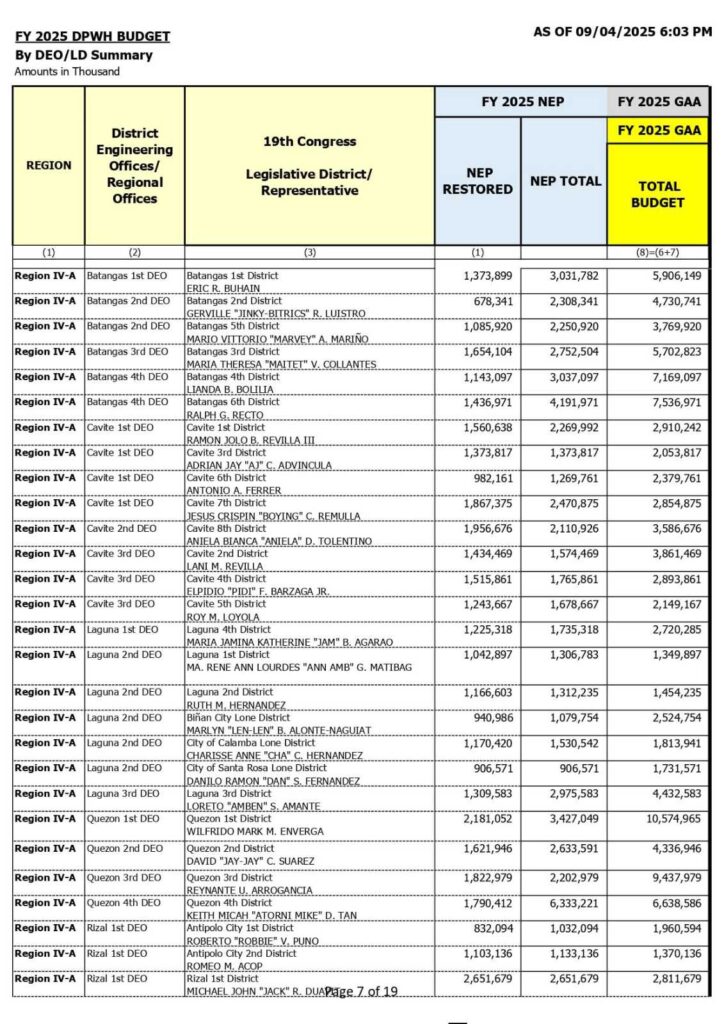
The release of these documents by Batangas Rep. Leandro Leviste has ignited a firestorm in Malacañang and the halls of Congress. Leviste alleges that the “NEP Restored” column represents “allocables”—funds essentially earmarked by individual lawmakers for pet projects, a practice critics argue mimics the outlawed Priority Development Assistance Fund (PDAF) or “pork barrel.”
The controversy is heightened by the mysterious death of Undersecretary Cabral, who was found dead in Benguet in mid-December. Her files reportedly list high-ranking officials, including Cabinet secretaries and all 24 senators, as “proponents” of over P1 trillion in infrastructure projects.
Senate President Pro Tempore Panfilo Lacson has recently flagged these patterns, noting that certain DPWH programs have spiked by over 100% between the executive proposal and the final law. Lacson warned that such “duplicate” and “unexplained” increases risk massive misuse of public funds and provide a breeding ground for “ghost projects.”
Defenses and Denials
In response to the “DPWH Leaks,” several lawmakers have denied personal involvement in the fund movements. House
Speaker Faustino Dy III dismissed the claims of secret insertions, maintaining that all budget items undergo a “proper and transparent process” during bicameral deliberations.
DPWH Secretary Vince Dizon has also defended the agency, stating that budget “restorations” are often necessary to cover funding shortfalls in essential projects like asphalt overlays and flood control, which may have been underfunded in the initial NEP.
However, transparency advocates argue the Cavite data reveals a “shadow budget” system where political influence, rather than engineering necessity, dictates the flow of billions in taxpayer money.
Discover more from Cavite News
Subscribe to get the latest posts sent to your email.